October 12, 2026 · 7-min read
How to Split Loot in D&D 5e Without Party Arguments
The dragon is defeated. Dividing its treasure shouldn't start the next fight.
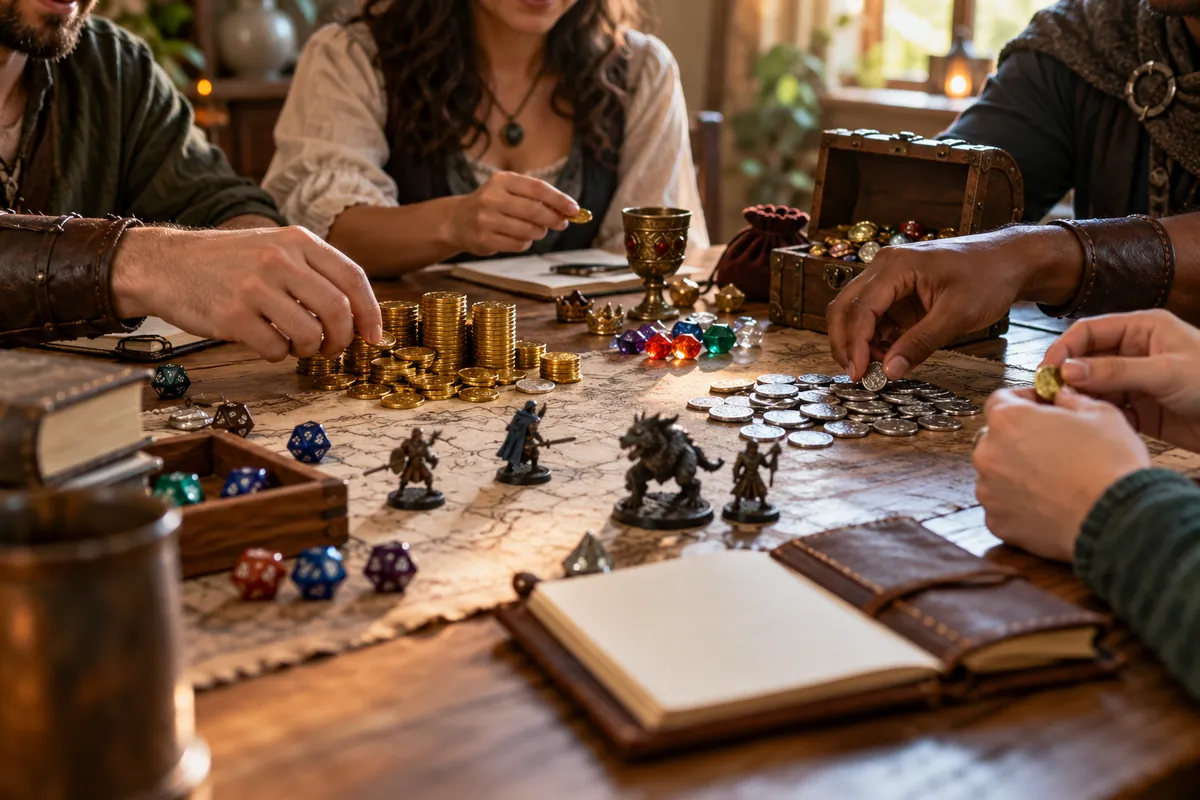
Split coins equally after agreed shared expenses, assign magic items by usefulness and rotating priority, and record every transfer in one party ledger. If you're deciding how to split loot in D&D 5e, agree on that process before anyone claims the treasure.
A fair system doesn't need to make every haul identical for every character. It needs to give everyone a voice, make decisions predictable, and keep quieter players from missing out.
The method below is a suggested table agreement, not a loot-distribution rule from the SRD 5.1.
What loot rules should your party agree on?
Settle four questions before your next treasure chest:
- What's shared? Treat treasure earned during group adventures as party property until divided.
- What gets paid first? Reimburse approved party expenses and contribute an agreed amount to a shared fund.
- How are items assigned? Use practical benefit first, then a rotating priority list.
- Who records decisions? Choose one treasurer, but make the record visible to everyone.
Define exceptions upfront. A character's starting equipment and personal purchases usually stay personal. A reward explicitly promised to one character deserves a quick discussion if the whole party helped earn it.
Use this copy-and-paste agreement:
Adventure loot goes into the party record first. We reimburse approved shared expenses, set aside our agreed party contribution, and split the remaining money equally. We assign useful items by discussion and rotating priority. Carrying an item doesn't automatically make it yours.
Also decide how absences work. Keeping absent regular players in the coin split is a simple default. Set aside an item they might want until they can weigh in, while allowing someone present to borrow it.
How do you divide coins, gems, and valuables?
For ordinary treasure, use this sequence:
- List what you actually have. Separate coins, gems, art objects, and unidentified items.
- Confirm values with the DM. Distinguish an estimated value from money actually received.
- Reimburse approved expenses. Pay back someone who covered a shared cost.
- Add the agreed party-fund contribution.
- Divide the remaining money equally.
Use a common denomination for bookkeeping. Under SRD 5.1 currency conversions, 1 gp equals 10 sp or 100 cp; 1 ep equals 5 sp, and 1 pp equals 10 gp. Recording a gold-piece equivalent doesn't mean the party physically exchanged the coins.
A four-character loot split
Four characters return with 640 gp in coins and sell several valuables for another 160 gp.
| Step | Amount | |---|---:| | Total available money | 800 gp | | Reimburse approved expedition supplies | −40 gp | | Add agreed amount to party fund | −120 gp | | Money available for individual shares | 640 gp | | Each of four characters receives | 160 gp |
The character being reimbursed receives 40 gp back plus their normal 160 gp share. Repayment isn't a bonus.
If treasure hasn't been sold, leave it in shared inventory. Alternatively, someone can take a gem against their share at a value everyone accepts. Don't distribute both the gem's estimated value and its eventual sale proceeds.
For awkward remainders, split into smaller denominations where practical or leave the remainder in the party fund.

How should you assign magic items fairly?
Separate permanent magic items from the coin split. Charging someone an assumed gold price for an item can create trouble when that price isn't established or selling it isn't practical in your campaign.
For each item, ask:
- Who can use it effectively?
- Does it replace something they already have?
- Does it require attunement, and can they accommodate it?
- Who has received fewer useful permanent items recently?
A character can normally be attuned to no more than three magic items under SRD 5.1 rules. Check any item's requirements before treating it as an immediate upgrade.
Need first, rotation second is a useful default. If only one character benefits meaningfully, let them take it if the group agrees. If multiple characters have a reasonable claim, use a standing priority list.
Use a rotation for competing claims
Randomize the initial order once. Whenever someone receives a useful permanent item, move their name to the bottom; among competing claimants, the highest name gets priority.
Suppose the order is Mira, Dain, Sol, then Tessa. Dain and Tessa both want a magic shield they can use. Dain receives it, and the new order becomes Mira, Sol, Tessa, Dain.
Passing doesn't move someone down. Neither does carrying a shared item or accepting something nobody wants. Record the decision so priority doesn't depend on memory.
Count meaningful benefits, not just item totals. A situational trinket and a frequently used weapon don't necessarily balance each other. For custom treasure, building a homebrew magic item without breaking your game can help the DM assess its usefulness before distribution.
Who should carry potions and shared equipment?
Assign consumables by likely use, not by making every backpack look identical.
A potion of healing helps only if someone can reach and use it. Spread emergency supplies among characters instead of putting everything on one person who might become separated or incapacitated.
Label each consumable or utility item as either:
- Personal: Assigned to a character to use at their discretion.
- Shared: Carried by a named character for agreed party purposes.
For shared resources, agree that using them in an emergency doesn't require a debate. Discuss expensive or unusual uses when there's time.
The carrier is responsible for tracking the item, not entitled to sell it. A rope, potion, or unusual key can remain party property while appearing in one character's inventory.
What belongs in the party loot tracker?
Keep one master record with enough detail to answer: What is it, where is it, and who owns it?
| Loot | Quantity or value | Holder | Status | |---|---|---|---| | Expedition reserve | 120 gp | Mira | Shared fund | | Potion of healing | 2 | Sol and Tessa, one each | Shared emergency supply | | Magic shield | 1 | Dain | Personal; rotation updated | | Silver statuette | Value unconfirmed | Mira | Shared; awaiting appraisal |
Add the session or location where treasure was found when useful. For unidentified items, write what the characters know rather than assuming properties.
For the party fund, record each transaction and its resulting balance:
Opening balance: 120 gp. Approved supplies: −15 gp. Closing balance: 105 gp.
At the end of a session, read back new assignments and purchases. Players then update their own sheets. This brief reconciliation catches missing potions and coins counted twice before they become next month's argument.
What should you do when players disagree?
Pause the allocation, not the whole adventure. Mark the disputed item as shared and return to the decision during a break or after the session.
Ask each claimant to explain the benefit briefly. Then apply your agreed rule. Avoid replacing the process with an impromptu persuasion contest that rewards whoever argues longest.
Common disputes need clear boundaries:
- “I opened the chest.” Finding shared adventure treasure doesn't grant first claim.
- “I dealt the most damage.” Don't base shares on damage; scouting, healing, and negotiation also support success.
- “My character would steal it.” Secretly taking party treasure requires player agreement to that kind of conflict.
- “I never get anything useful.” Review the record and upcoming opportunities; equal item counts may conceal unequal benefits.
The DM can clarify item properties and facilitate the conversation. Players should still have a say in their party's agreement.
If the rule failed, revise it for future treasure. Reopening settled allocations should require everyone's agreement, not one player's frustration.
How can you make loot division a quick habit?
Finish each treasure allocation with four checks:
- Every discovered item is recorded.
- Coins and reimbursements add up.
- Each assigned item has an owner or shared designation.
- Personal inventories and the party record agree.
Keep an unresolved-item list so one complicated decision doesn't block everything else.
If your group prefers paper, the DnD Encounter and Loot Tracker Printable is an option for keeping treasure notes alongside encounter records. A notebook works too; the useful habit is recording decisions where everyone can check them.
Before opening the next chest, agree on the coin split, party fund, and item rotation. Then let the treasure be a reward everyone can enjoy.
Parchment & Dice is not affiliated with Wizards of the Coast.
Frequently asked questions
- Does D&D 5e have an official rule for splitting loot?
- The SRD 5.1 does not prescribe a party loot-sharing formula. Equal coin shares, shared funds, and rotating magic item priority are table agreements.
- Should the character who finds treasure get to keep it?
- Finding treasure does not have to mean owning it. For treasure earned during a group adventure, a practical default is to record it as party loot unless everyone agreed otherwise.
- Should a player who missed a session still get treasure?
- Decide this before attendance becomes an issue. A low-friction option is to give absent regular members an equal coin share and delay permanent allocation of items they might reasonably want.
- Do you subtract a magic item's value from someone's gold?
- Only if your group agreed to that system. Tracking useful permanent items separately from coins avoids relying on uncertain resale values.
- dnd 5e
- loot
- dm advice
- party treasure
- magic items
Related reading
- How to Assign Stat Blocks to a City NPC in MinutesA fast method for picking a dnd npc stat block for city encounters, using SRD monsters as reskinned stand-ins so you never stall a scene.
- How to Build a D&D NPC Generator TableBuild a D&D NPC generator table that gives you quick names, motives, mannerisms, and useful hooks during play.
- How to Run a Bar Brawl Encounter Without It Getting SillyClear dnd bar brawl encounter rules for running a tavern fight that stays fun and nonlethal instead of spiraling into a real fight.