
October 9, 2026 · 7-min read
How to Assign Stat Blocks to a City NPC in Minutes
Your players just picked a fight with a fishmonger. Here's how to stat her in under a minute.
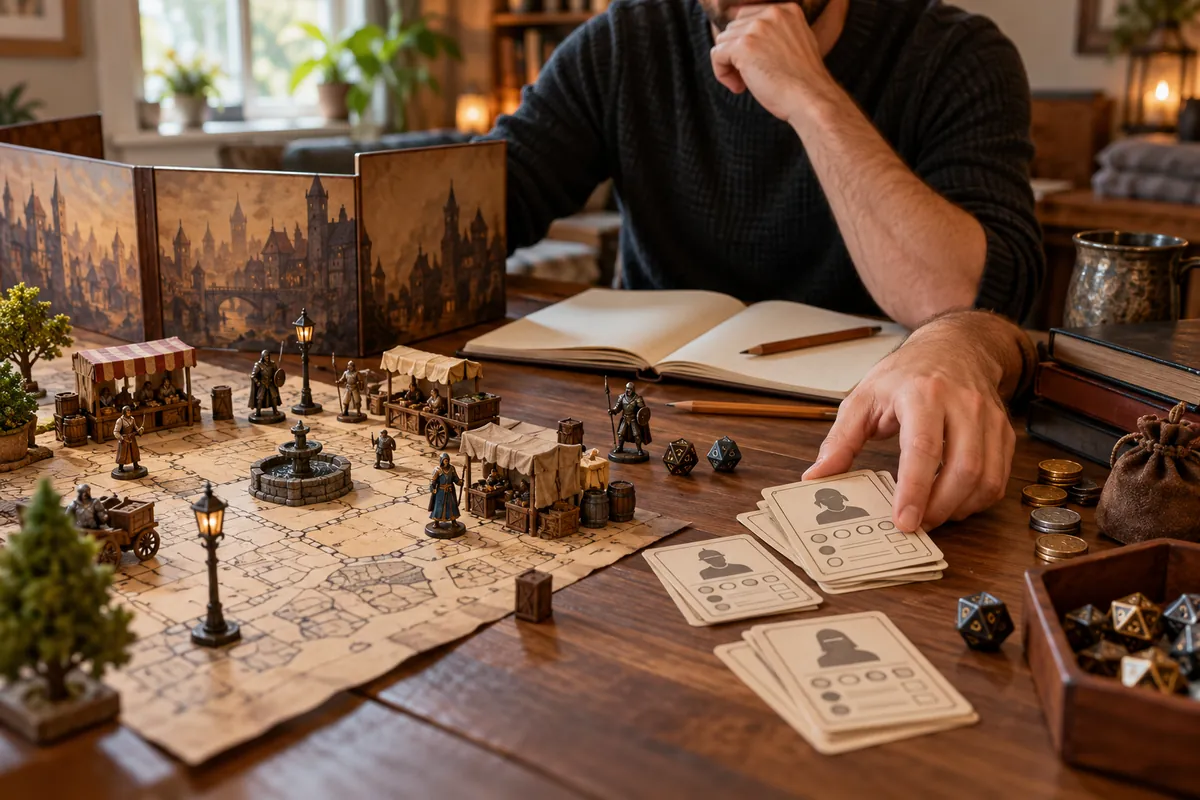
The fastest way to assign a stat block to a city NPC is to skip building one from scratch and instead match the NPC's role to the closest SRD stat block by profession, then rename and reskin it. A dnd npc stat block for city encounters almost never needs custom math. It needs a template you can grab in the moment.
Urban scenes break this way more than dungeons do, because cities are full of named, talkative people the party might shove, threaten, or swing a mace at. If you're reaching for the Monster Manual mid-scene, you've already lost momentum. Here's the system that keeps it moving.
Why do city NPCs need stat blocks at all?
Any NPC the party can touch, talk back to, or try to kill needs enough of a stat block to resolve the outcome fairly.
That doesn't mean every NPC needs full combat stats. It means every NPC needs:
- An Armor Class, so you can resolve a surprise shove or a thrown drink
- A passive Perception, so you know if they notice the pickpocket or the forged letter
- A general combat capability, in case things go sideways
Most city NPCs are built once and reused constantly. A good base library of five or six stat blocks covers 90% of what shows up in a market, tavern, or noble's court.
What SRD stat blocks cover most city roles?
The SRD gives you a small set of humanoid stat blocks that map cleanly onto urban archetypes. You rarely need anything outside this list:
- Commoner — shopkeepers, dockhands, farmers visiting for market day, street performers
- Guard — city watch, gate sentries, hired muscle at a warehouse
- Noble — merchants of standing, minor aristocrats, guild masters
- Spy — informants, fixers, anyone running a double game
- Bandit — thugs, smugglers, anyone openly looking for trouble
- Veteran — retired soldiers, bodyguards, a captain of the guard
- Mage or Priest — hedge wizards, temple clergy, licensed spellcasters
That's seven stat blocks. Learn those seven and you can stat almost any face the party meets on a city street without opening a second book.
How do I pick the right stat block fast?
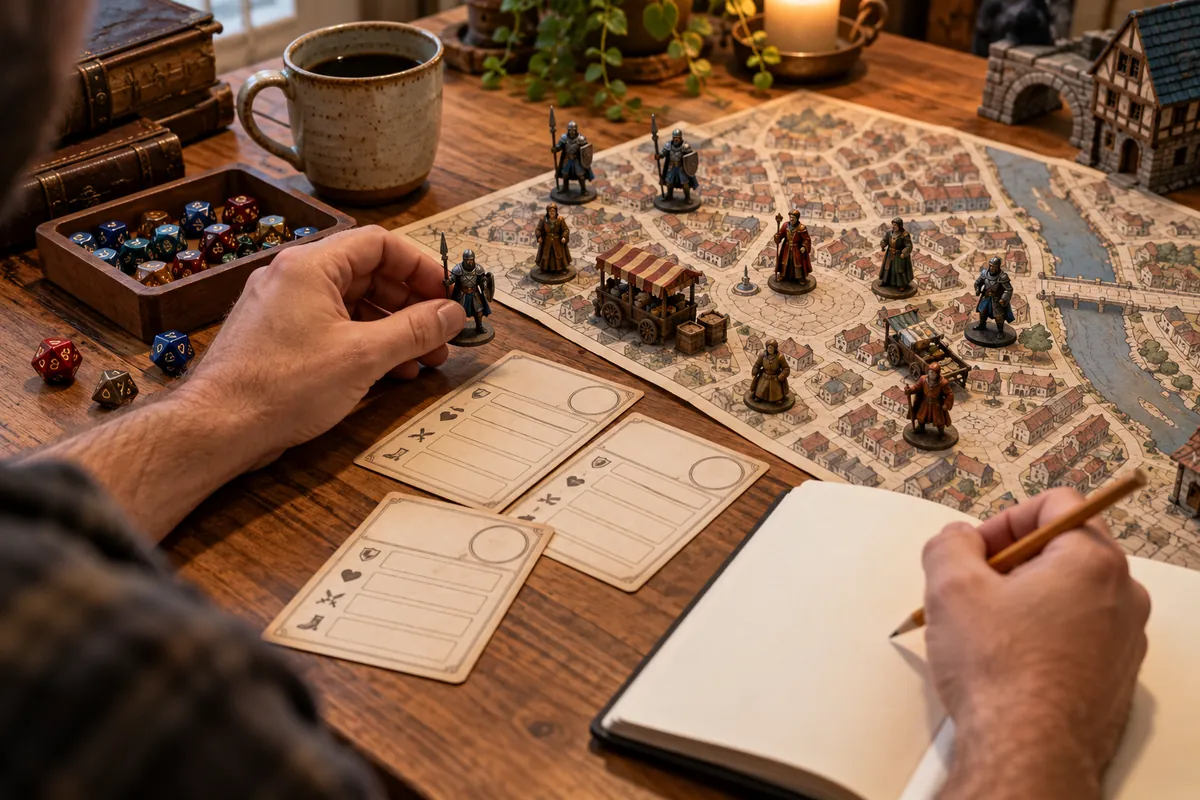
Ask yourself one question: what does this NPC do if the conversation turns violent? The answer sorts them into a tier almost instantly.
Step 1: Sort by threat tier, not profession. A blacksmith and a baker are both Commoners. A bouncer and a city guard are both Guards. Profession is flavor; threat tier is mechanics.
Step 2: Match tier to stat block.
- Harmless or untrained → Commoner
- Armed and trained, low stakes → Guard
- Socially powerful, physically soft → Noble
- Quietly dangerous or deceptive → Spy
- Openly violent, low discipline → Bandit
- Hardened professional → Veteran
- Any kind of caster → Mage or Priest
Step 3: Rename and reskin on the fly. Don't rebuild stats. Change the name, the two sentences of personality, and maybe the weapon description. The spear in the Guard block can be a halberd, a glaive, or a fancy city-watch pike without touching a single number.
Step 4: Write a one-line hook so they're not forgettable. Even a throwaway NPC is more fun with a want. "Wants the party to stop blocking her cart" turns a stat block into a scene.
This whole process should take under a minute once you've internalized the seven blocks above. It's also the same instinct that makes prepping balanced fights faster in general — if you haven't read Building Your First Balanced Encounter, the tier-matching logic there pairs well with this approach.
What should I do when the scene escalates unexpectedly?
Keep a short mental ladder so you can step an NPC up without stopping the game to redesign them.
- Commoner escalates to → Bandit (they panic and swing, badly)
- Guard escalates to → Veteran (reinforcements or the sergeant arrives)
- Noble escalates to → Spy or Assassin (the mask comes off)
- Spy escalates to → Assassin (the job goes loud)
This matters because players love testing boundaries with background characters. A shopkeeper getting slapped around shouldn't suddenly fight like a dragon, but they also shouldn't be a pushover if the party picked the wrong shopkeeper. The ladder keeps escalation plausible instead of arbitrary.
It's also worth having passive Perception numbers ready before the scene starts, especially for guards and spies who are supposed to notice things. If you want a quick refresher on the math, How to Calculate Passive Perception for D&D Monsters and NPCs walks through it in under five minutes.
How detailed should a background NPC really be?
Only as detailed as the scene demands, and no further.
A good rule: write three things per NPC, max, until they prove they matter.
- Stat block (one of the seven above, unmodified)
- One voice note — a verbal tic, a catchphrase, a speaking quirk
- One hook — what they want right now
If the party latches onto an NPC and starts building a relationship with them, that's when you invest more. Giving every market vendor a backstory before anyone talks to them is prep time you'll never get back.
How do I keep a city's NPCs from feeling copy-pasted?
Vary the hook and voice, not the stats. Players remember personality, not AC.
A few cheap variation tricks:
- Give each Commoner a different relationship to money (desperate, greedy, generous, indifferent)
- Give each Guard a different attitude toward the law (by-the-book, bribable, bored, zealous)
- Give Nobles contradictory public and private goals
Three Commoners with three different wants feel like three different people, even though their stat block is identical down to the hit point total.
A soft shortcut for session night
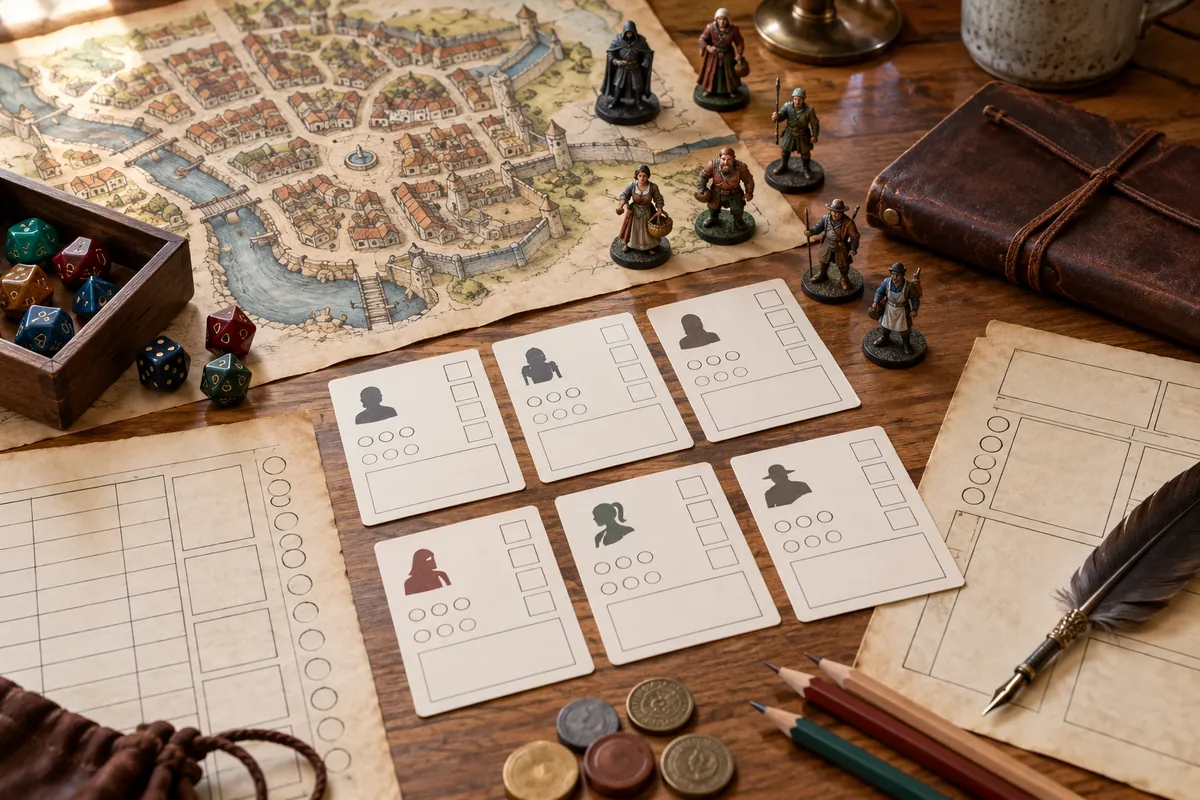
If you'd rather not rebuild this list from scratch every time you plan a market scene or a noble's dinner party, that's exactly the gap the City NPC Cards for DnD 5e pack is built for: 16 ready-to-drop urban NPCs with stat blocks, a voice note, and a hook already written, in both A4 and letter sizes. It's the same seven-block logic above, just pre-sorted and printed so you can hand one to a player or lay it on the table mid-scene. You can browse the rest of the printable toolkit at the shop if you're stocking up for a longer campaign.
This post isn't affiliated with Wizards of the Coast, and all mechanics referenced here come from the free SRD 5.1 rules, not from any Monster Manual content beyond that.
Once your city NPCs are sorted, the next slow point in most urban sessions is combat pacing. If guard fights or tavern brawls tend to drag at your table, How Long Should a D&D Turn Take? Speeding Up Combat is a natural next read.
Frequently asked questions
- Do city NPCs need a full stat block if they're not going to fight?
- No. Give background NPCs like merchants and clerks just an AC, a passive Perception, and maybe a skill bonus for lies or haggling. Save full stat blocks for anyone the party might actually attack or who might attack them.
- What stat block should I use for a city guard in D&D 5e?
- The SRD Guard stat block (AC 16, 11 HP, a spear) covers most patrol and watch-post guards. For a captain or elite escort, step up to the Veteran stat block instead.
- Can I use the same stat block for multiple different NPCs?
- Yes, and you should. One Commoner block can be a baker, a dockhand, and a street musician in the same session. Reskin the name, voice, and motive, not the numbers.
- How do I make a noble NPC feel dangerous without homebrewing a new monster?
- Give them a Noble stat block for the social layer, then attach a hidden Spy or Assassin block for when the mask comes off. Players only see the second block if the scene turns violent.
- dnd 5e
- npc design
- dm tools
- city encounters
- stat blocks
- game prep
Related reading
- How to Build a D&D NPC Generator TableBuild a D&D NPC generator table that gives you quick names, motives, mannerisms, and useful hooks during play.
- How to Run a Bar Brawl Encounter Without It Getting SillyClear dnd bar brawl encounter rules for running a tavern fight that stays fun and nonlethal instead of spiraling into a real fight.
- How to Calculate Passive Perception for D&D Monsters and NPCsLearn how to calculate passive perception in D&D 5e for any monster or NPC, plus how to use it to run ambushes and stealth checks fairly.