August 17, 2026 · 7-min read
How to Read Aloud Boxed Text Without Losing the Room
The room goes quiet the second you start reading, and not in a good way. Here's how to fix that.

Read boxed text slowly, in short sentences, and stop as soon as you have set the scene, not after you have described everything in it. The moment players have enough to act on, hand control back to them, because boxed text that keeps going past that point is where you lose the room.
Every DM has felt it. You start reading the atmospheric paragraph from the module, look up halfway through, and someone is already checking their phone. It is not that your players do not care. It is that boxed text is written to be read silently on a page, not read aloud at a table where six people are waiting for something to do. The fix is not to stop using it. It is to change how you deliver it.
How do I prepare boxed text before the session?
Never read boxed text cold. Even a thirty-second skim beforehand changes everything, because you stop stumbling over unfamiliar phrasing and start sounding like you actually know the place.
Before the session:
- Read every boxed text passage you might hit that night, out loud, once, even quietly to yourself.
- Cut anything that will not matter to the players in the next five minutes. Save the rest for later if it becomes relevant.
- Mark one or two sensory details you want to land hardest, so you know where to slow down.
- If a passage is long, split it into two shorter chunks with a natural pause between them.
This is the same instinct behind planning an encounter before you run it rather than winging the math at the table. If you have not read our piece on building your first balanced encounter, the prep habits carry over directly: a few minutes ahead of time saves you from fumbling in front of the group.
What should I actually say out loud?
Say less than the book gives you. Published boxed text is often written for a reader flipping pages, not a listener sitting at a table, so it tends to over-describe.
A good rule: three to five sentences, covering what the characters would notice in the first ten seconds of walking into a space. Cut adjectives that do not change a decision. "The cold, ancient, weathered stone door looms before you" can just be "a stone door blocks the passage, worn smooth at the edges." Shorter lands harder.
If the source text is long, do not panic and read it all in one breath. Break it into two beats:
- The immediate physical scene (what's in front of them, right now).
- One detail that raises a question (a sound, a smell, something out of place).
That second beat is what pulls players forward instead of letting them sit back and listen.
How do I keep players' attention while reading?
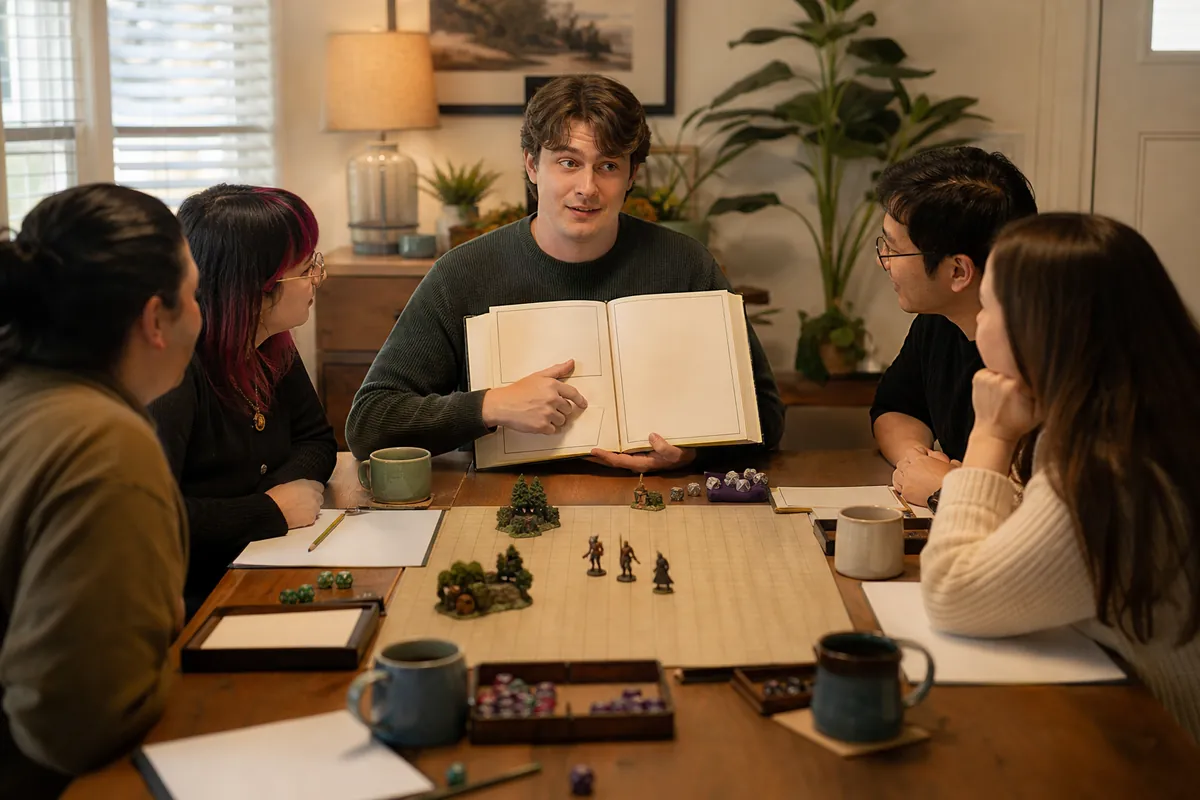
Attention drops the second your delivery goes flat. A few small habits fix most of it.
- Slow down, especially at the start. Most new DMs read boxed text too fast because they are nervous. Cut your pace by roughly a third.
- Make eye contact between sentences, not during them. Look at your notes to read the line, then look up to deliver it.
- Use silence on purpose. A one-second pause after a key detail does more work than raising your voice.
- Drop your voice slightly for tension, not volume for excitement. A quieter, slower line about a dark corridor reads as more ominous than a loud one.
- Watch the table, not the page. If eyes are wandering by sentence two, you are running long. Wrap it up and ask a question instead.
That last point matters because boxed text is not a performance you finish no matter what. It is scene-setting in service of play. If you notice the room drifting, the fix is not to push through faster or louder. It is to stop a sentence early and hand it back to them with something like "what do you do?"
Should I read it word for word or paraphrase?
Read word for word when the exact wording carries information the players need to act on correctly, like an inscription, a riddle, or a message with specific phrasing. Paraphrase everything else.
Verbatim reading works for:
- Notes, letters, or carved text the characters are literally reading in-fiction
- Prophecies or riddles where exact wording matters to solving them
- NPC dialogue you want delivered with precision
Paraphrasing works better for:
- General room and environment description
- Anything you have shortened from the source material
- Scenes where you want to react to what players are already doing rather than deliver a fixed script
A useful test: if a player could reasonably ask "wait, can you say that again?" and it would matter, read it word for word. If not, paraphrase and move on.
How do I handle boxed text mid-combat?
Keep it to one sentence, delivered between turns, not during them. Combat has its own pacing, and long narration in the middle of a fight is one of the most common ways turns slow to a crawl. If you've run into that problem generally, our guide on speeding up combat turns covers the wider fix, but the boxed text version of it is simple: save the atmosphere for before initiative rolls, and keep anything you add once combat starts short enough to say in a single breath.
What if players interrupt or split up?
Let them. Boxed text is not sacred. If someone asks a question halfway through, answer it, then pick the description back up or skip the rest if the answer already covered it. If the party splits and only some characters are in the scene, read a shorter version for that subgroup rather than repeating the whole passage word for word to the table.
This is really the same skill as reading the table in any improvised moment, not just during prepared narration. If your players tend to go off in directions you did not plan for, the same instincts covered in reading a room and improvising when players go off-script apply directly here: watch, adjust, and do not force a script past the point where it is working.
How much boxed text is too much?
If it takes longer than about fifteen to twenty seconds to read, it is probably too long for most tables. That is roughly three to five sentences at a natural pace. Longer than that, and you are asking players to sit passively for a stretch of time a session rarely has room for.
When you are prepping ahead of a session, it helps to have your key scene descriptions, NPC voices, and pacing reminders somewhere you can glance at quickly instead of flipping through a module mid-read. A lot of DMs keep a one-page reference nearby for exactly that reason. The DnD DM Reference Pack Printable 5e is built around that same idea, with room to jot your own trimmed-down boxed text notes next to the tables you already reach for during a session. If you want to see what else is available for stocking a DM's toolkit, the full shop has the rest of the printable range.
Boxed text is not affiliated with Wizards of the Coast as a fixed rule, and none of the above requires reproducing anything beyond what the SRD 5.1 allows. It is a delivery habit, and like most delivery habits, it gets better with a little trimming and a lot of eye contact.
Frequently asked questions
- Is it okay to skip boxed text entirely?
- Yes. Boxed text is a tool, not a requirement, and plenty of good DMs paraphrase instead of reading it verbatim. Use it when the wording matters and skip it when a shorter description will do the same job.
- Should players ever read boxed text aloud instead of the DM?
- It works well for letters, inscriptions, or messages a character finds, since handing over the physical or read-aloud moment makes the discovery feel more real. It works less well for scene-setting narration, which usually lands better coming from the DM.
- How long should boxed text be for a new DM?
- Aim for three to five sentences, or about fifteen seconds of reading time. If you find yourself needing more, break it into two shorter beats with a pause or a question in between.
- What's the difference between boxed text and flavor text?
- Boxed text usually refers to the printed, read-aloud passages in published adventures, while flavor text is a broader term for any descriptive color a DM adds. In practice most tables use the words interchangeably.
- dm technique
- boxed text
- narration
- running a game
- 5e tips
- dungeon master
Related reading
- How to Make a D&D Tavern Menu Your Players Will UseLearn how to make a D&D tavern menu with clear prices, memorable dishes, and useful choices your players can use at the table.
- How to Introduce Your Friends to D&DHow to introduce your friends to D&D: start with a short one-shot, pre-built characters, and a simple plan so everyone has fun at the table.
- How to Make NPCs Your Players Actually RememberHow to make memorable NPCs in D&D: give each one a clear want, a single quirk, and a distinct voice your players can latch onto in seconds.