July 17, 2026 · 8-min read
How to Read a D&D Stat Block: Monster Symbols Explained
That wall of numbers above a monster's description is actually a cheat sheet built to make you look good at the table.

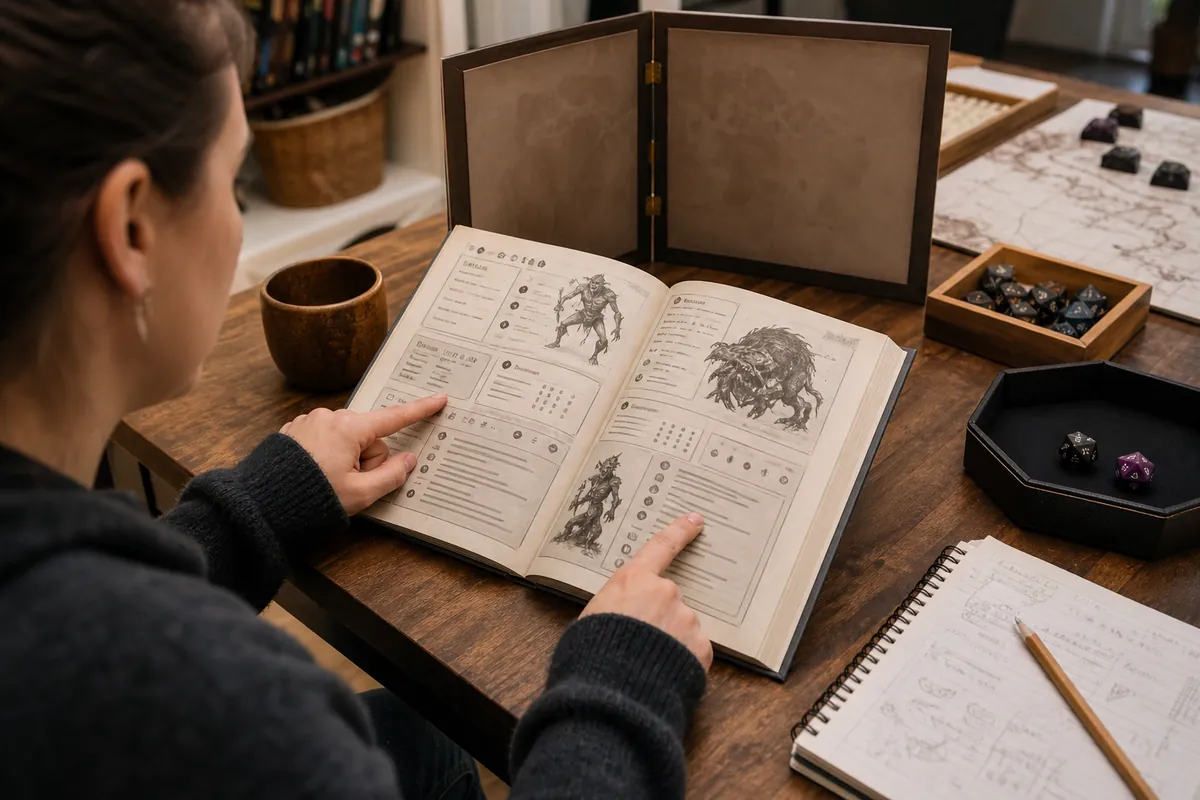
A D&D stat block is the compact profile under a monster's name that tells you everything you need to run it: how hard it is to hit, how much damage it can take, what it senses, and what it can do on its turn. Once you know what each line means, reading one takes seconds, not minutes, even mid-combat.
New DMs often freeze the first time they flip open a Monster Manual-style entry. It looks dense, full of abbreviations and numbers packed into a tiny space. But every stat block follows the same layout every time, so once you learn the pattern once, you can read any monster in the game.
What's at the top of a stat block?
The header gives you the monster's identity before any numbers show up.
- Name — the monster's title, sometimes with a subtype in parentheses (like "Goblin Boss").
- Size and type — for example, "Medium humanoid (goblinoid)," telling you how much space it takes up and what category it belongs to for spells and effects that target certain types.
- Alignment — its general moral and ethical leaning, useful for roleplay and predicting behavior, not a hard rule.
Right below that sits Armor Class (AC), the number an attacker's d20 roll plus modifiers needs to meet or beat to land a hit. A higher AC means the monster is harder to hit. Some stat blocks add a note in parentheses, like "(natural armor)" or "(shield)," explaining where that AC comes from.
Next to AC you'll find Hit Points (HP), usually shown as a flat number with a dice formula beside it, such as "45 (6d8 + 18)." That formula is there so you can reroll HP for variety if you want a slightly different toughness each time you use the monster.
Speed lists how far the creature moves on its turn, and often includes extra movement types like fly, swim, or burrow with their own distances. A monster with "30 ft., fly 60 ft." can walk normally or take to the air, and knowing that in advance stops you from being caught off guard when it does something unexpected mid-fight.
How do I read the six ability scores?
Below the header sits a row of six abilities: Strength, Dexterity, Constitution, Intelligence, Wisdom, and Charisma. Each shows a score and a modifier in parentheses, like "16 (+3)."
The modifier is the number that actually matters at the table. It's what gets added to attack rolls, saving throws, and skill checks tied to that ability, so you can mostly ignore the raw score and just use the modifier in parentheses.
A quick way to read them at a glance:
- High Strength and Constitution usually mean a hard-hitting melee brute.
- High Dexterity often signals a skirmisher with good AC or a ranged attacker.
- High Intelligence, Wisdom, or Charisma points toward spellcasting or social tricks.
This pattern lets you predict a monster's fighting style before you even read its actions.
What do saving throws and skills mean?
Not every monster lists saving throws or skills, only the ones where it's noticeably better than its ability scores alone would suggest.
Saving throws show which of the six abilities the monster is proficient in for resisting effects. If a stat block lists "Dex +5," that monster is unusually good at dodging things like fireballs or traps, even if its base Dexterity modifier looks average.
Skills work the same way. A monster with "Perception +4, Stealth +5" is trained to notice things and sneak around, which matters when your players try to ambush it or sneak past it.
Below those, you'll often see:
- Damage resistances — types of damage the monster takes half damage from.
- Damage immunities — types of damage it ignores completely.
- Condition immunities — conditions, like poisoned or frightened, that simply don't affect it.
- Senses — special detection like darkvision, blindsight, or truesight, plus its passive Perception, the number it uses automatically to notice hidden creatures without you rolling anything (see How to Calculate Passive Perception in D&D 5e (With Examples) if you need to work one out for a creature you build yourself).
- Languages — what it can understand or speak, occasionally listed as "—" meaning none.
Passive Perception is worth flagging on your prep notes before a session; it's the fastest way to adjudicate whether a monster spots a sneaking rogue without slowing the table down. If you want a system for keeping that kind of note handy during play, our piece on organizing a DM binder that actually helps at the table covers how to build quick-reference pages for exactly this.
What does Challenge Rating actually tell me?
Challenge Rating (CR) is a rough estimate of how tough a monster is meant to be for an appropriately leveled party to fight and win, often paired with an experience point (XP) value in parentheses. That XP value is what gets split between the party after the fight; How Much XP to Level Up in D&D 5e? Levels 1–20 Table lists the XP for the common low CRs and the XP each level needs.
Treat CR as a starting point, not gospel. A single CR 5 monster can wreck a party of four level 3 characters, while the same monster might be a mild speed bump for six level 6 characters. If you're still building out your feel for encounter math, our guide on building your first balanced encounter walks through combining CR with party size properly.
How do I read the actions and traits sections?
This is where the stat block tells you what the monster actually does, and it's usually split into a few labeled sections.
- Traits — passive abilities that are always active, like "Pack Tactics" (advantage on attacks when an ally is nearby) or "Amphibious" (can breathe air and water). These sit above the Actions header and shape how the monster behaves even before it acts.
- Actions — what the monster can do on its turn, most commonly an attack entry. A line like "Melee Weapon Attack: +5 to hit, reach 5 ft., one target. Hit: 7 (1d8 + 3) slashing damage" tells you the attack bonus to roll against AC, the range, and the damage on a hit.
- Reactions — abilities it can use on someone else's turn, in response to a trigger, such as an opportunity attack variant.
- Legendary Actions — found only on powerful solo monsters like dragons or liches. These let the monster act a limited number of times between other creatures' turns, which is exactly what keeps a single boss monster from being trivialized by a full party acting in a row.
Reading actions in order, top to bottom, generally reflects the order a smart monster would use them, so it doubles as a decent default script for how to play it.
How can I get faster at reading stat blocks at the table?
Speed comes from repetition and from having the right numbers visible without flipping pages mid-combat.
- Highlight or circle the AC, HP, and key attack bonus before the session starts.
- Pre-roll HP for common monsters instead of relying on the average, so you're not doing math while the table waits.
- Note any resistances or immunities on a sticky note if a monster is going to be a recurring threat.
- Read the traits section first; passive abilities often change how you should be running the fight from round one, not just when an action triggers.
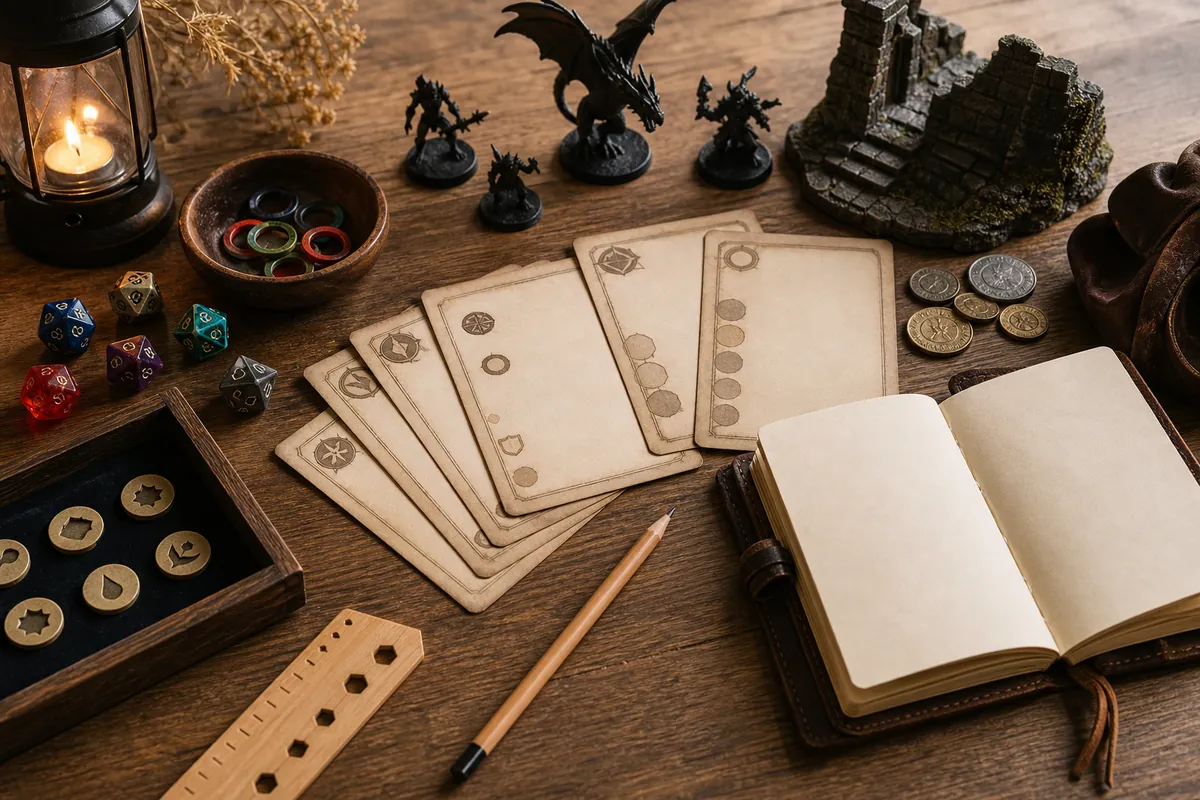
If you run monsters often, it also helps to have a physical reference you can scribble on and reuse between sessions. A lot of DMs keep a set of index-card-style references at hand for exactly this reason, and our blank DnD monster cards printable is built to let you fill in a homebrewed or reskinned monster's AC, HP, saves, and actions in the same layout described above, so your own creations read just as fast as an official stat block. It's a small thing, but it saves real time once you're three encounters into a session.
For a broader look at what else is worth keeping in easy reach during a game, our shop has printable tools built around the same table-ready philosophy.
Final thoughts
A stat block only looks intimidating the first few times you read one. Once the layout clicks, header, abilities, saves and senses, then actions, it becomes one of the fastest reference tools in the game, and running monsters with confidence stops being about memorizing rules and starts being about knowing where to look.
Frequently asked questions
- What does CR mean in a D&D stat block?
- CR stands for Challenge Rating, a rough guide to how tough a monster is meant to be for a party of a given level. It is a helpful starting point for encounter building, not a precise combat calculator, so always sanity-check it against your actual party size and level.
- What is the difference between AC and HP on a stat block?
- AC, or Armor Class, is the number an attack roll needs to meet or beat to hit the monster. HP, or Hit Points, is how much damage the monster can take before it drops. One is about being hit, the other is about surviving being hit.
- Do all monsters have legendary actions?
- No, only certain powerful monsters, usually solo bosses like dragons or liches, have a legendary actions section. Most standard monsters do not have one, so if you do not see that heading, the monster simply does not use them.
- What does a monster's passive Perception score actually do?
- Passive Perception is the number the monster uses automatically to notice hidden or sneaking creatures, without you having to roll for it. Compare it to a player's Stealth check total to decide silently whether the monster spots them.
- dm help
- monsters
- stat blocks
- 5e rules
- dungeon master tips
Related reading
- How to Make a D&D Magic Item Feel Legendary, Not Just UsefulLearn how to make DnD magic items feel special with sensory detail, personality, and history instead of just stat bonuses.
- How to Assign Stat Blocks to a City NPC in MinutesA fast method for picking a dnd npc stat block for city encounters, using SRD monsters as reskinned stand-ins so you never stall a scene.
- D&D 5e Bar Fight Rules: How to Run a Nonlethal Tavern BrawlRun a D&D 5e bar fight without a TPK: make all damage nonlethal, cap brawlers at 3–5 with 4–10 HP, use improvised weapons and set a clear end.